
The Thinking
Not broken is not good enough
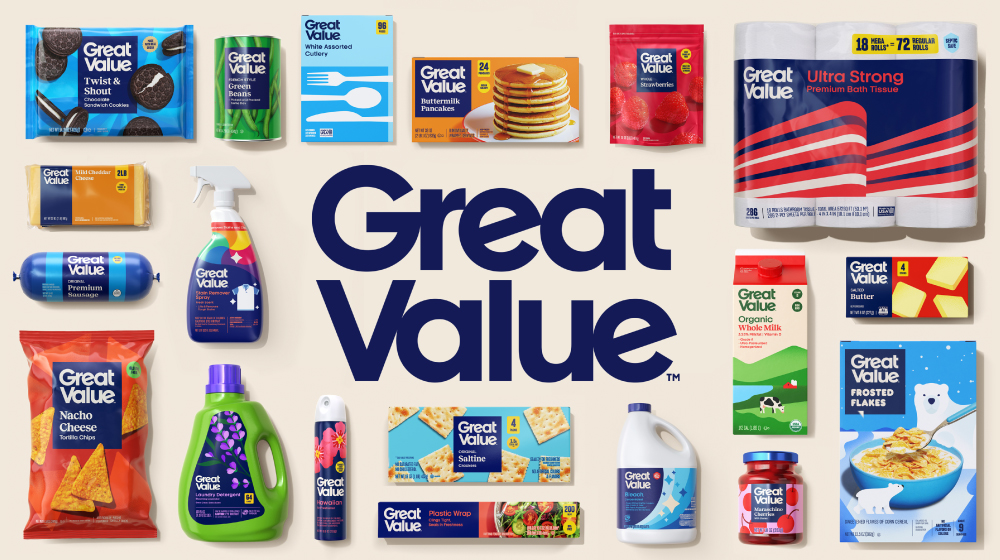
On a brand finally allowed out of the cupboard.
You have probably done this without thinking about it.
Someone is coming over for dinner. You pull the pasta out of the cupboard and tip it into a different container. You move the cereal box behind the nicer one on the counter. You decant the dish soap into something glass.
The product is fine. It has always been fine. It is just not something you want to leave out.
Walmart has spent the last few years studying that exact instinct. Last month, they announced one of the largest rebrands ever undertaken by a single company — a complete redesign of Great Value, their flagship private label. Ten thousand products. Two years to roll out. Nine in ten American households touched by it.
The reason they gave is the part worth sitting with.
Customers liked the quality. They liked the price. They trusted the brand enough to put it in their cart every week. What they did not like was how it looked on their counter.
The product was working. The way it showed up was not.
The product was working. The way it showed up was not.
That gap — between what something is and how it is experienced — is where most real brand work happens.
It is also where most businesses never look. The product is selling. The customers are buying. Nothing is technically wrong.
Nothing was technically wrong with Great Value either. That is what makes the decision interesting.
There is an idea, written about most clearly by Will Guidara in his book on hospitality, that excellence lives in the small, almost irrational amount of care taken over the things most people do not register. The detail nobody asked you to notice. The touchpoint that was already fine.
A rebrand of ten thousand products that were already selling is that idea at scale.
It is a company deciding that "fine" is not the standard. Even for the things that have been fine forever.
Especially for those.
The Great Value redesign does not exist in isolation. It follows a refresh of the parent company brand. It sits alongside Bettergoods, the higher-end private label launched two years ago. It is part of a deliberate climb.
A company known for one thing has spent years carefully earning the right to be known for another. Each move in that sequence has been more public than the last — until this one.
This one is different. This is the move that touches the most lives.
And it was aimed at the part of the brand customers had stopped seeing. The thing they encounter so often they no longer notice it.
That is usually where the real gap lives.
It is a company deciding that "fine" is not the standard. Even for the things that have been fine forever.
The reason this matters — even if you do not run a retail empire — is that every business has its own version of the Great Value bag in the pantry.
The touchpoint that is working well enough. The asset nobody has questioned in years. The customer experience that has been "fine" since the company was founded.
It is almost never the thing the founder is worried about. The things founders worry about get attention by default.
It is the thing that has been quietly doing its job for so long that nobody thinks to look at it anymore.
The invoice that goes out every month and looks like every other invoice. The onboarding email that was written when the company was three people. The packaging your customer opens and forgets — when it could have been the moment they remembered you for.
The proposal template. The signage. The thank-you page after a purchase.
These are the small, repeated, daily places where your brand actually lives in your customers' lives.
Ask most founders where their brand shows up and they will name the obvious things. The website. The logo. The social channels.
The honest answer is that it shows up wherever a customer encounters you. And the places they encounter you the most are almost never the places that get the most care.
Walmart, with all its scale, just decided those quiet touchpoints were worth two years of work. Not because anything was broken. Because "not broken" is not the same as "good enough."
"Not broken" is not the same as "good enough."
The thing worth taking from this is not about packaging.
Look at the parts of your business that have been fine for the longest. The places nobody has questioned in years. The interactions your customer has with you that you have stopped paying attention to because they have been working.
That is where your gap is.
You do not need a thirty-year-old private label to find it. You just need to be willing to look at the things you have been quietly walking past.
If this piece resonated,
let's have a real conversation.
The first conversation is free. And it's always real — not a pitch, not a discovery form.