Coming to the App Store
Your spreadsheet is going to cost you a bonus.
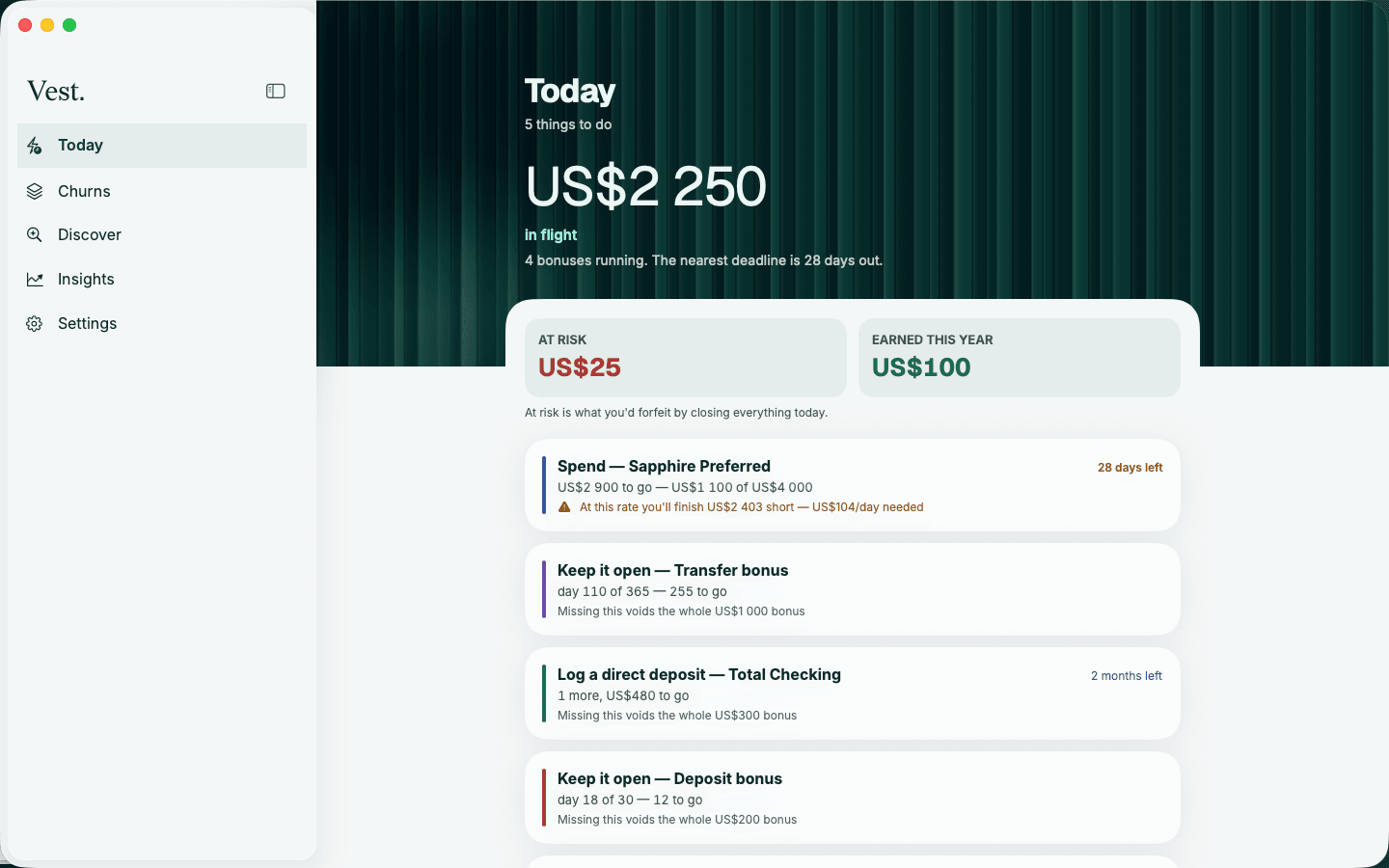
Six offers in flight. Four deadlines, each anchored to a different date. A 5/24 count you’re doing in your head. It works right up until the week it doesn’t — and a missed minimum spend doesn’t cost you a little, it costs you the whole bonus.
Vest holds all of it. The dates, the arithmetic, every issuer’s clock — and it’s the only tracker that will tell you when an offer isn’t worth taking at all.
No bank login. No account. Nothing leaves your phone.
No bank login. Ever.
Every other money app opens with a password field. Vest doesn’t have the screen.
You hold twenty accounts across a dozen institutions. Handing that whole picture to an aggregator so it can guess at your spending is a bad trade, and it’s one you’ve probably already turned down once.
So Vest never asks. There’s no aggregator, no OAuth handshake, no read-only access, and nothing sitting on a server waiting to be breached — because a bonus tracker that needs your banking password is a bonus tracker that can leak your banking password.
Zero
bank connections
Not switched off — absent. There is no aggregator, no OAuth handshake and no screen-scraper anywhere in the app.
Three
requests it ever makes
The offer list, the issuer-rules list, and a page fetch when you ask it to read an offer. All anonymous. That's the whole list.
Nothing
we could hand over
No account, no analytics, no servers. If someone demanded your data tomorrow, there is nothing here to give them.
Deadlines that don’t sneak up
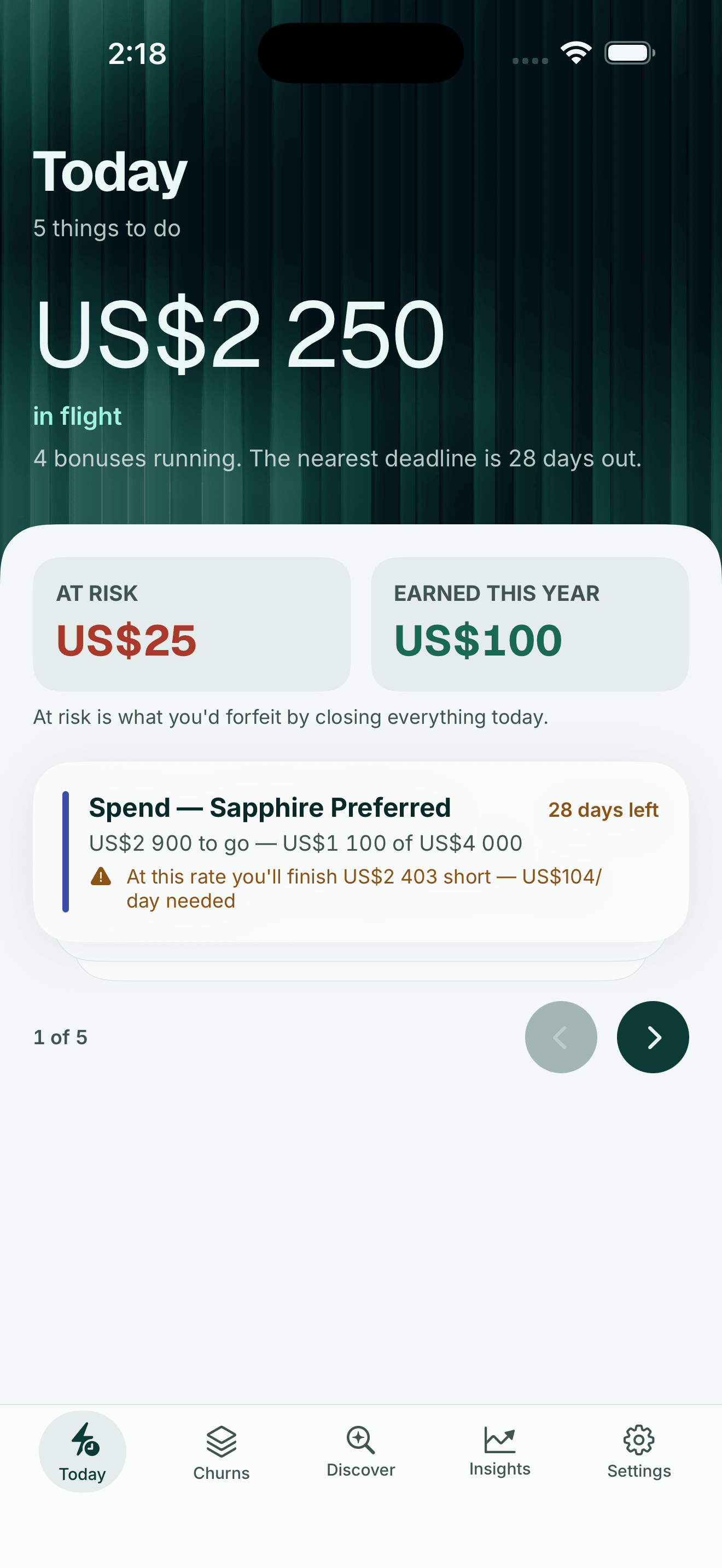
“28 days left” is how people lose $750.
Four weeks sounds like plenty. It is plenty — right up until you do the division and find you needed to be spending $104 a day since the card arrived, and you’ve been managing forty.
By the time a calendar reminder fires, the bonus is already gone. Vest watches both numbers from day one and tells you the moment they stop agreeing.
What your calendar says
28 days left
Relax. Four weeks is ages. This is the number every other tracker shows you, and it is the one that gets people.
What the arithmetic says
US$2,403 short
At the rate you have actually been spending, you finish two grand under and the whole bonus goes. You needed to know this three weeks ago.
Both are true at once. Vest tells you the second one while there is still time to do something about it — and every requirement gets the same treatment, anchored to the date that actually starts its clock, counted in months where the offer says months and in days where it says days.
Before you apply, not after
A hard pull you didn’t need is a 24-month mistake.
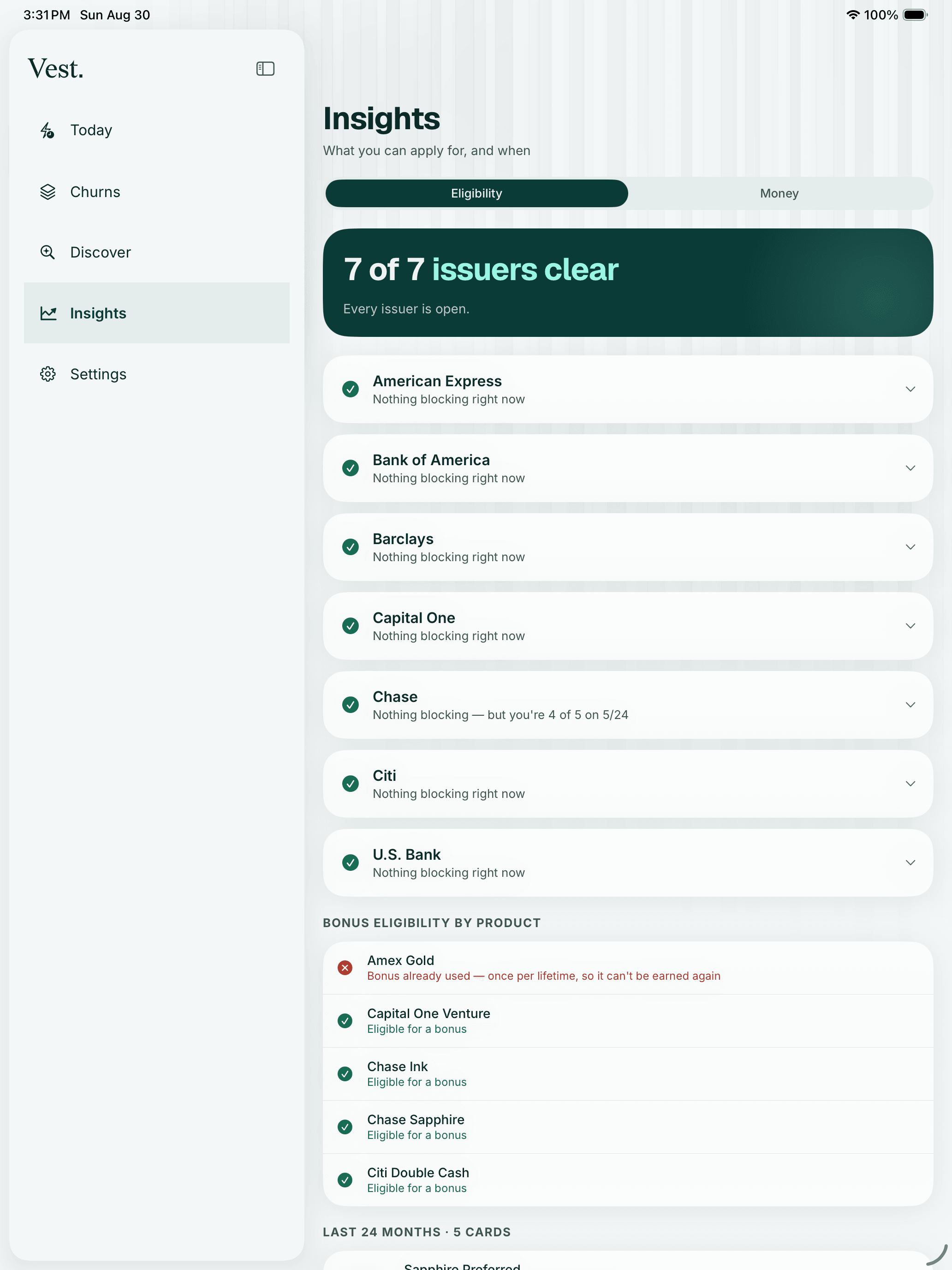
You know roughly where you are on 5/24. Roughly is what costs you the application — one authorised-user card you forgot about, one business card you assumed didn’t count, and the answer changes.
Vest keeps the count exactly, for every issuer, and shows its working so you can check it. Open the app before you open a new tab.
Chase 5/24
Counts every personal card at any issuer — plus the Capital One, Discover and TD business cards that report personally and catch people out.
Amex once-per-lifetime
One welcome offer per product, ever. Vest remembers which bonus was paid on which product, so a product change doesn't quietly un-burn it.
Citi's 48-month clock
Which restarts when you close a card, not when you open one. Tidy up your wallet and you can restart a four-year wait without noticing.
And it will never tell you that you’ll be approved. That is a lending decision made by a model nobody outside the bank can see. Any app confident enough to predict it is one that will eventually cost you a pull — so Vest gives you counts and dates, and leaves the call where it belongs.
The rules are data, not code. Each shows a confidence level and when it was last checked, and a correction reaches your phone the same day instead of waiting two weeks for an App Store review.
The bonus you shouldn’t take
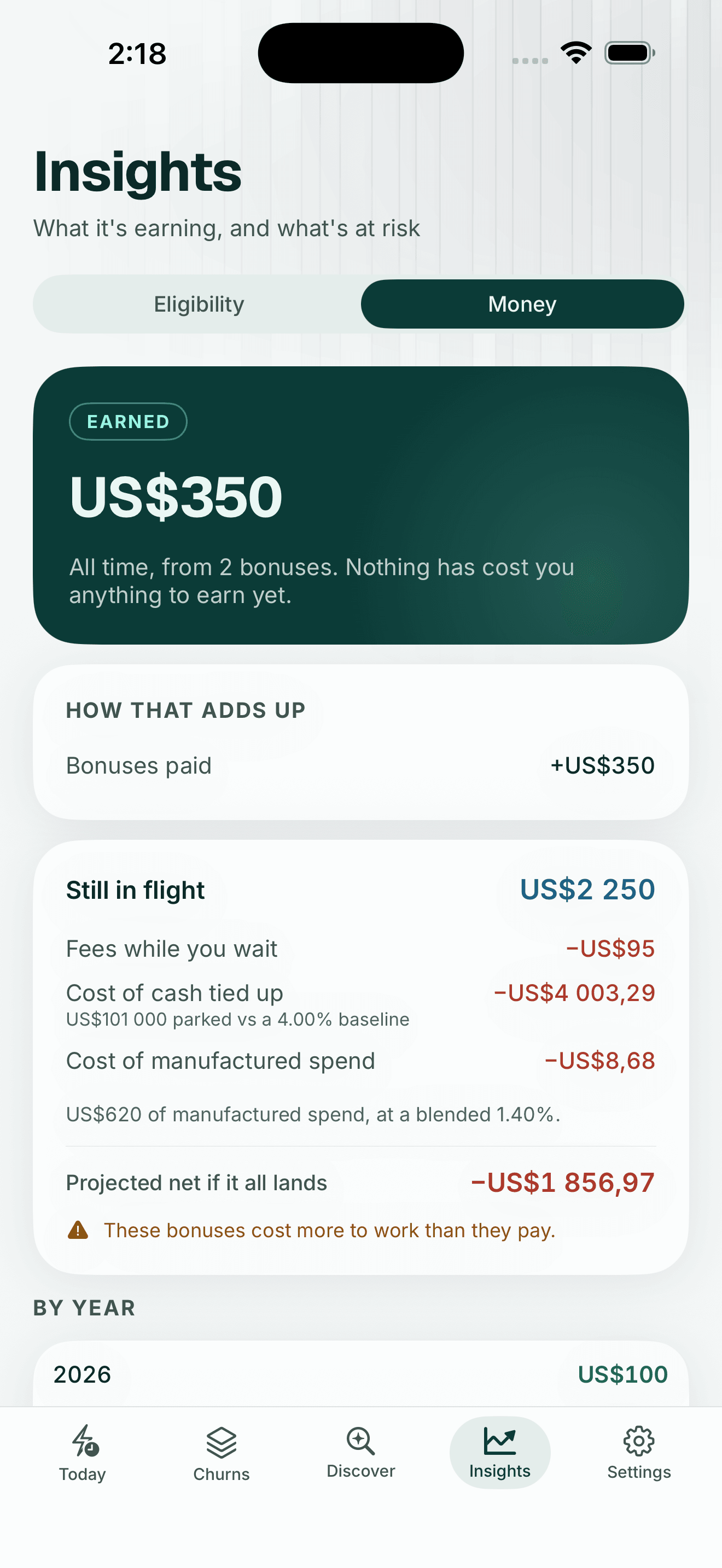
A $1,000 brokerage bonus can lose you money. Vest is the one that says so.
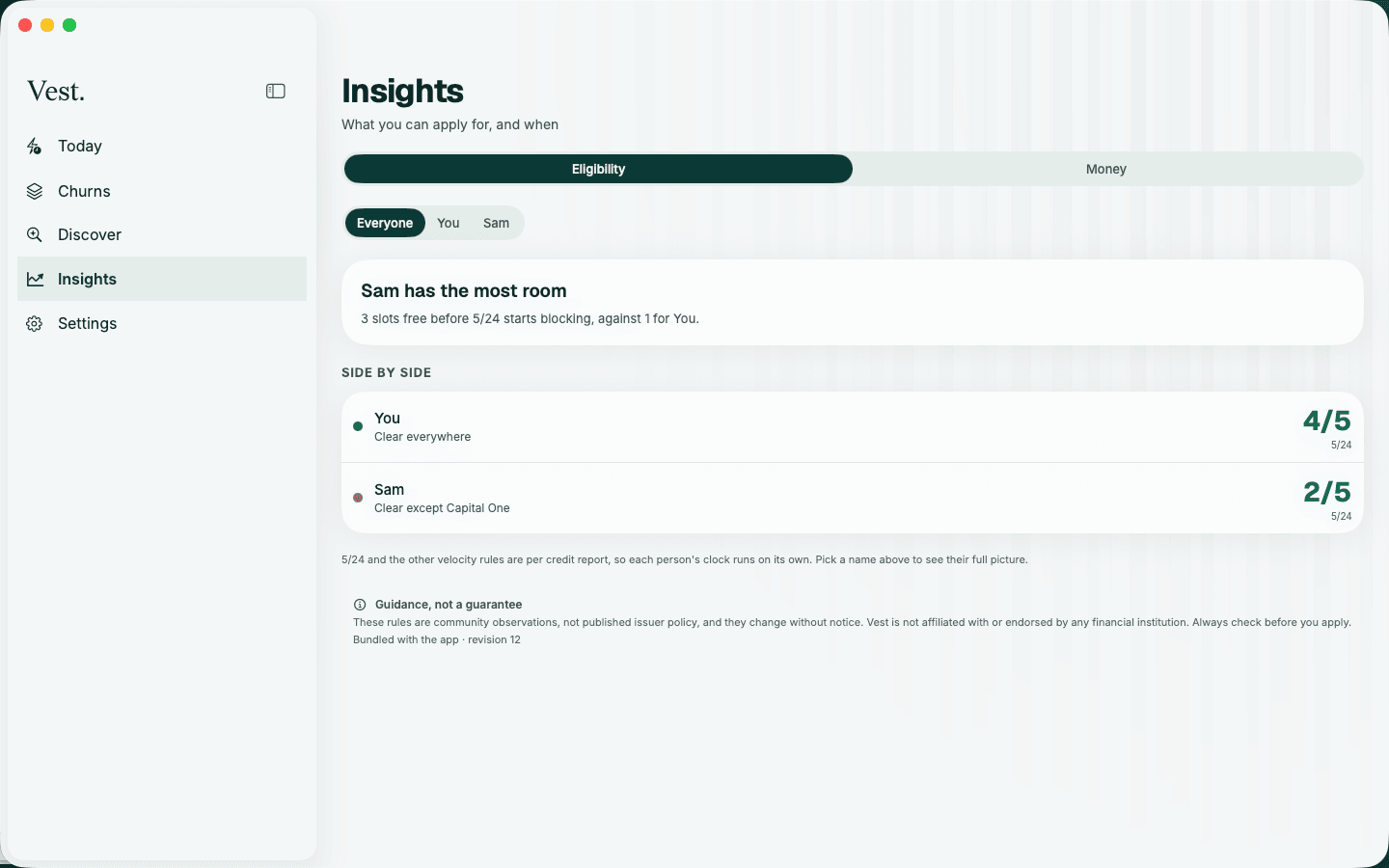
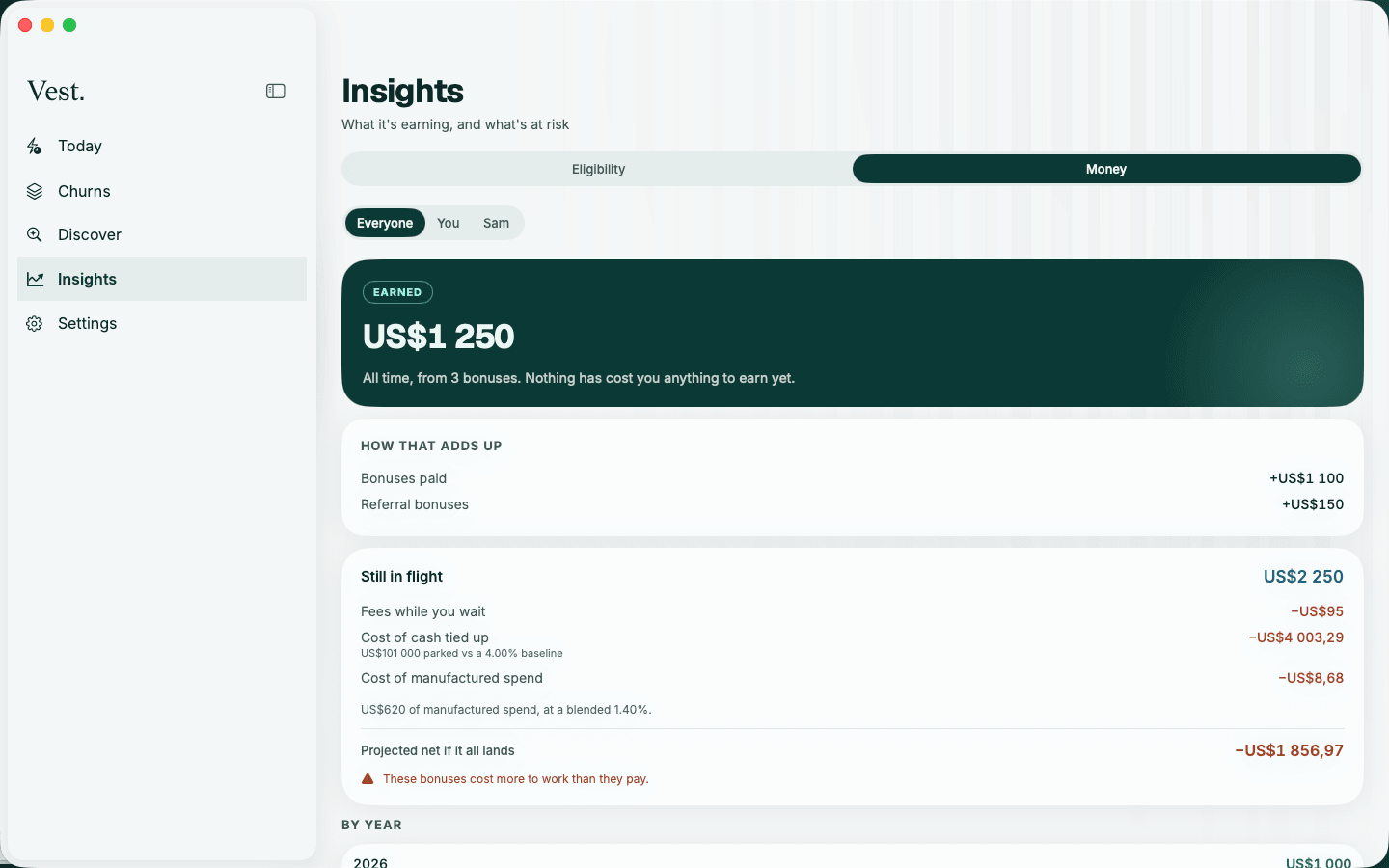
Park $100,000 for twelve months to earn $1,000, and you have quietly given up a few thousand in interest to do it. The offer page will not mention that. Neither will any other tracker — they add up headline bonuses and call it profit.
What’s left when everything’s counted.
Annual fees. Monthly fees you meant to get waived. What the cash cost you to park. What the spend cost you to generate. Every one of them charged against the bonus that caused it — so the number you end up looking at is what you actually made, not what the marketing said.
Sometimes that number is negative. Vest tells you before you commit, which is the only time it is any use.
It handles the way out, too. Clawback windows, early-termination fees, minimum holding periods — so “can I close this yet?” has a date on it instead of a shrug.
More than one player
“Whose turn is it for this one?”
A good offer lands and more than one of you could take it. One is at 4/24, one is clear, one burned that lifetime bonus in 2023 and has forgotten. Guess wrong and it’s a pull wasted on the person who could least afford it.
Add everyone you actually churn with — a partner, a parent, whoever else is in the rotation. Vest keeps a separate set of clocks for each and lines them up so you can see at a glance who has room.
Compared, never combined. 5/24 is per credit report, so there is no such thing as a household 5/24 — and an app that quietly adds you together is giving every one of you a wrong answer.
Refer each other and it follows that too, so the bonus lands on the right person’s tax year instead of being remembered wrong in January.
Four ways in
You’ll type far less than you’re expecting.
“No bank connection” sounds like it means data entry. It doesn’t. Almost nothing here has to be typed — and the one job you do have to keep up, logging what you spent, takes a tap from the Lock Screen.
- Share it from Safari
- Find an offer, hit share, pick Vest. Next time you open the app it offers to read the page for you — you check what it found rather than typing it.
- Take it from the feed
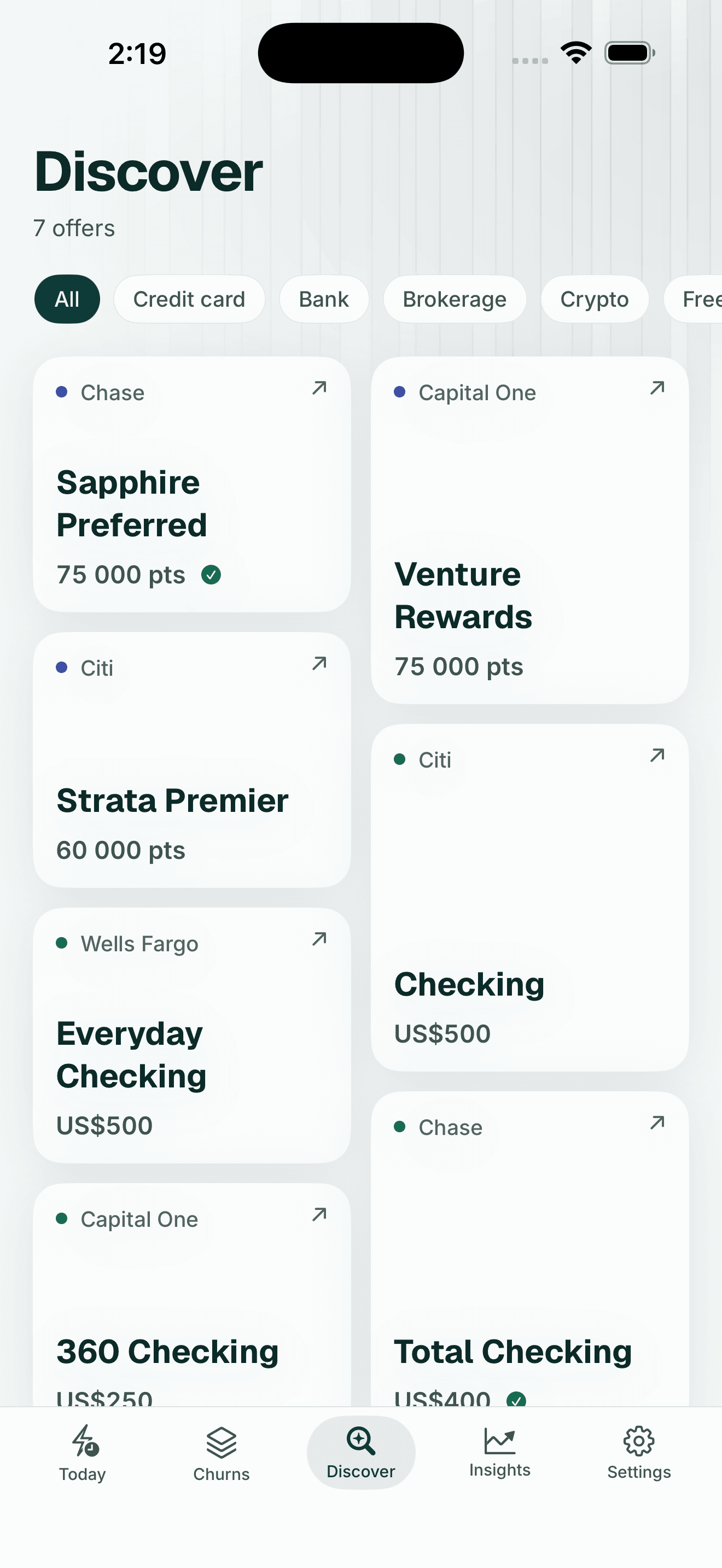
- A curated list of live offers, each with a source link so you can check the claim yourself. Tap track and it becomes a bonus you're running.
- Bring your spreadsheet
- Import a CSV and map the columns yourself. It tells you plainly what it couldn't bring across, rather than dropping it and saying nothing.
- Tick it off from the Home Screen
- The Quick log widget clears countable things — a debit transaction, a bill payment — with one tap and no app. Lock Screen widgets show what's due; ask Siri for the rest.
January
Forms turn up for accounts you closed in March.
Eleven months later, a 1099 arrives from a bank whose name you barely recognise, for a bonus you’d stopped thinking about. Then a second one for a referral, which is a different kind of income entirely and gets its own form.
Vest has been keeping the tally all year. Bank bonuses are interest and get a 1099-INT; referrals are miscellaneous income and get a 1099-MISC. It keeps them apart, totals them by year and institution, knows which business entity a card was opened under, and hands you a CSV — so you reconcile what arrived against what you were expecting, rather than trying to remember.
It reports the amounts you are expecting. It does not calculate tax owed, and it is not tax advice.
Privacy
There is nothing here to breach.
Most apps promise to look after your data. Vest doesn’t have any of it to look after — no account, no servers, no analytics, no crash reporting that phones home, and not one third-party SDK.
That’s a design decision with a cost we chose to pay: it means no web dashboard, no cross-platform sync service, no growth analytics telling us which screens you use. What you get for it is an App Privacy label reading “Data Not Collected” that is the literal truth rather than a careful reading.
Every request the app makes. The whole list.
- 01An anonymous download of the offer list.
- 02An anonymous download of the issuer-rules list.
- 03A fetch of an offer page you have explicitly asked Smart Add to read — the only request that goes anywhere we don’t control, and only when you ask for it.
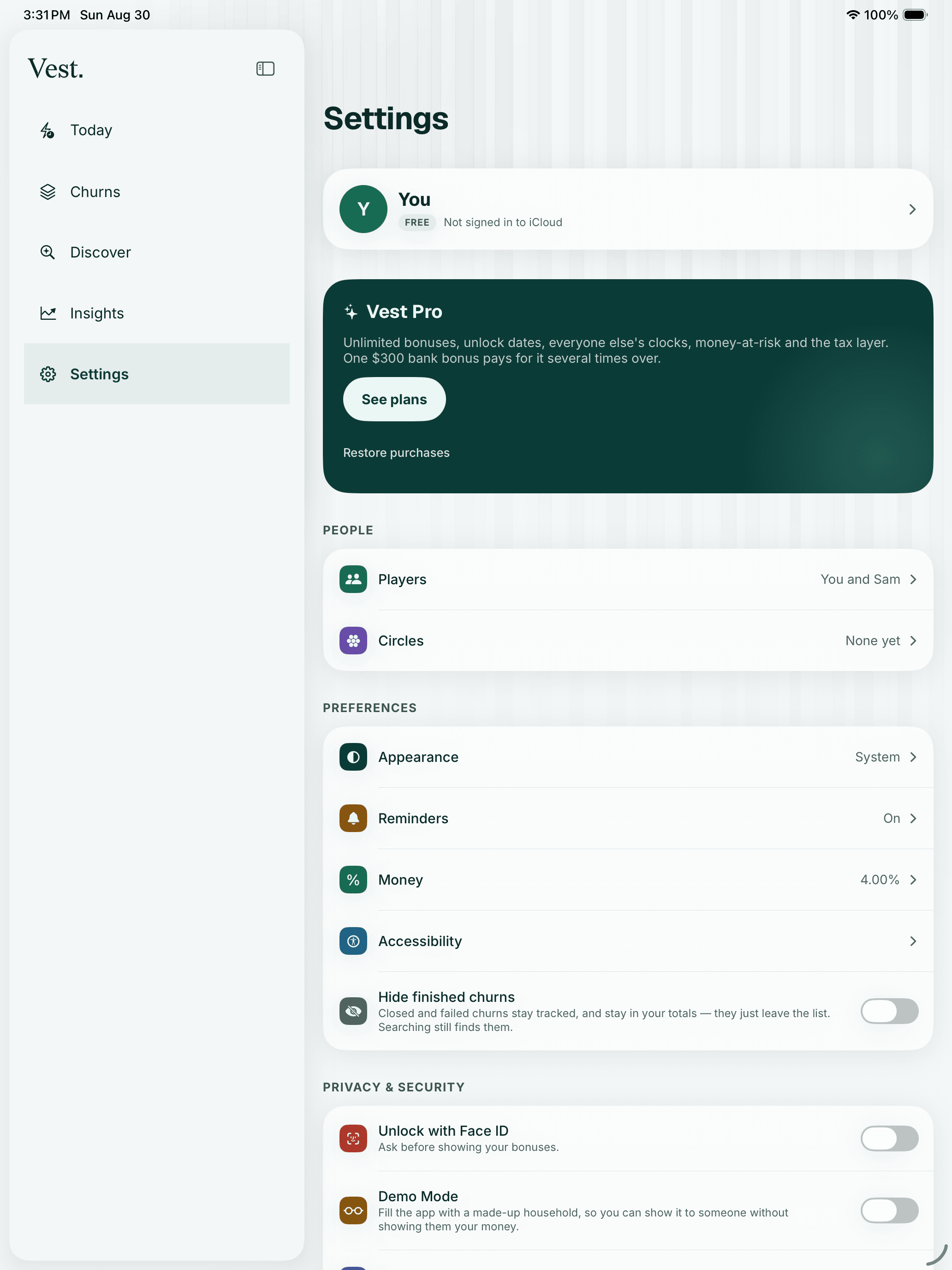
Your records live on your phone. If you have iCloud on, iOS also keeps a copy in your own private iCloud database — storage we cannot read. Turn it off and everything stays on the device.
Free, and Pro
Free isn’t a trial. It’s the app, with three bonuses.
Every core thing works without paying: the deadlines, the reminders, the offer feed, and your live standing with every issuer — including the count that matters, in full. If you run three bonuses at a time, you may never need more.
Pro is for when you’re past that. And if it ever lapses, you keep every bonus you were running and can still edit all of them — Vest is a map of your own money and it will not hold your records hostage to get you back.
Free
$0
The whole app, three bonuses at a time. No card, no trial clock.
- Three active bonuses
- All four categories, every requirement type
- Deadlines and reminders
- The deal feed, with its category filter
- Your standing with every issuer — including the count that matters, in full
Pro
7 days free$29.99/year
or $4.99 a month, or $79.99 once and never again.
- Unlimited active bonuses
- The unlock dates, and the 24-month timeline
- Every other player you track, each on their own clocks
- Money at risk, and net return after every cost
- The tax layer and its CSV export
- Unlimited Smart Add
US dollars. Apple charges in your local currency at its own rates, and the app shows you the real figure before you buy anything.
Questions
The ones you’re actually asking.
Does Vest connect to my bank?
No — and there is no setting that would let it. No aggregator, no OAuth handshake, no screen-scraper anywhere in the app. You bring the offers in yourself, and the share sheet, the offer feed and a CSV import do most of that for you.
Will it tell me whether I'll be approved?
No, and that is on purpose. It tells you how many accounts fall inside each issuer’s window, which product families are on cooldown, and the date the oldest one rolls out — facts you can check. Approval is a lending decision made by a model nobody outside the bank can see, and an app confident enough to guess at it will eventually cost you a pull. There is a build check that fails if that line is ever crossed in the app’s own wording.
Where do the issuer rules come from?
The same place you do: community datapoints. Issuers don’t publish these rules and change them without announcing it. So every rule shows you how confident it is and when it was last checked, rather than presenting itself as gospel — and because they’re delivered as data, a correction reaches your phone the same day instead of waiting two weeks for an App Store review.
Is my data on your servers?
There are no servers. There is no account and nothing to log into. Your records live on your phone, plus a copy in your own private iCloud database if you have iCloud switched on — storage we have no credentials for and cannot read.
What happens if I stop paying for Pro?
You keep every bonus you were already running and can still edit all of them. What you lose is the ability to start new ones past three, and the Pro-only screens. Nothing you entered gets taken away or held hostage — the whole point is that these are your records.
Is it available yet?
Not yet. It’s built and it works; what’s left is having every issuer rule checked by someone who didn’t write it, legal sign-off, and testing on real hardware. There’s no App Store button on this page because there’s nothing honest to point it at yet.
Not out yet
It ships when someone who didn't write the rules has checked them.
Vest is built and it works. What stands between here and the App Store is an expert review of every issuer rule, legal sign-off, and testing on real hardware — because a wrong rule isn’t a bug report, it’s a wrong answer about somebody’s credit. We’d rather be late than be that.